Course Content
UNIT 1 – INTRODUCTION TO DAIRY CATTLE PRODUCTION
After successful completion of unit one, students will able to:  Define and use correctly key terminologies related to dairy production and the dairy industry.  Describe the role of dairy production in the world economy and identify major features of the dairy industry.  Discuss the potentials and constraints of dairy production and development in Ethiopia, showing an appreciation for its socio-economic impact.  Classify and compare different dairy cattle production systems found in the tropics.  Explain and evaluate the advantages and disadvantages of keeping dairy cattle under various production systems.
0/7
UNIT 2 – BREEDS OF DAIRY CATTLE AND DISTRIBUTION
In unit two, you will be introduced to the diversity of dairy cattle breeds and their distribution, with a focus on both exotic and indigenous breeds. You will begin by exploring the fundamental reasons why animals, particularly cattle, differ from one another, examining distinctive characteristics such as body conformation, fitness traits related to adaptability and disease resistance, and production traits tied to milk yield and quality. This foundational understanding will then guide you into the classification of dairy cattle breeds into local (Bos indicus) and exotic (Bos taurus) types, highlighting how their unique features determine their suitability to various environments and management systems. Following this, you will delve into detailed profiles of the most well-known exotic dairy cattle breeds, including Holstein Friesian, Ayrshire, Jersey, Guernsey, and Brown Swiss, learning about their origins, physical features, milk production capacities, and adaptability. You will also examine these breeds through illustrative figures that help visualize their typical appearances. The unit will then shift to the rich diversity of Ethiopian indigenous dairy cattle breeds, such as Barca, Arsi, Fogera, Boran, Horro, Ogaden, Sheko, and Senga. You will learn how these breeds have evolved under local conditions to provide milk, meat, and draft power, while maintaining resilience to Ethiopia’s varied climates and disease challenges. Pictures included throughout will help you recognize these breeds in practice. By the end of this unit, you will not only have a clear appreciation of the breeds commonly used for dairy production both globally and in Ethiopia, but also understand why the right breed choice matters for achieving sustainable dairy development under different production systems.
0/21
UNIT 3 – DAIRY CATTLE HOUSING AND MANAGEMENT
In unit three, students will acquaint themselves with the dairy cattle housing importance, types of dairy cattle houses, and management of dairy cattle at different physiological stages. The importance of dairy cattle houses and types of dairy houses will be covered in the first section of the unit. Next to this section, students will learn about the management of different groups of animals in dairy cattle production.
0/19
UNIT 4 – REPRODUCTION AND BREEDING OF DAIRY CATTLE
In unit four, you will explore the vital biological and management aspects that underpin the reproductive efficiency and genetic improvement of dairy herds. You will understand the reproductive system of dairy cattle and the dynamics of the oestrus cycle, which are essential for making informed breeding decisions and ensuring high conception rates. You will also examine how to select appropriate dairy breeds, discuss key economically important traits that influence milk production and herd profitability, and study various selection methods that help achieve desirable genetic progress. Additionally, you will learn about the different methods of impregnation, including natural mating using bulls and the widespread use of artificial insemination (AI), which plays a critical role in modern dairy herd management. By the end of this chapter, you will appreciate how reproduction and breeding practices contribute to herd productivity, animal welfare, and the overall success of dairy enterprises. This knowledge will be fundamental for designing effective breeding programs, improving herd genetics, and supporting sustainable dairy production.
0/21
Dairy Cattle Production and Management

6.8.1. Genetic Factor

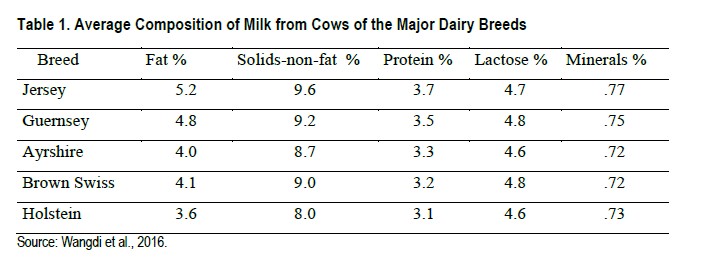
There are obvious differences in milk yield and composition between breeds. The most obvious difference between average milk compositions for breeds is fat percentage. There are obvious differences in milk composition and yield among the various breeds of dairy cattle.

Fat is the most variable constituent of milk whereas minerals (ash) and lactose are the least variable. Differences in gene frequencies controlling the quantity and quality of milk components largely account for the average genetic differences among breeds.

However, differences among individuals within a breed are often greater than differences among breeds. For example, some Holsteins produce milk containing more than 5% fat, and some Jersey produce milk testing as low as the breed average for Holsteins.

The diameter of the milk fat droplet varies from 1 to 10 microns. Guernsey’s have the largest and Holsteins and Ayrshire’s the smallest fat particles.

In general, the higher the fat percentage in milk the larger is the diameter of the fat particle. Also, its size usually decreases as the stage of lactation advances. Carotene, a yellow pigment, is the precursor of vitamin A. Guernsey and Jersey cows convert much less carotene to vitamin A than other breeds of dairy cattle. Thus, milk from Guernsey and Jersey cows is coloured yellow. Humans convert the carotene to vitamin A; thus, milk from these cows provides about as many vitamin A equivalents as milk from other breeds (see Table 1 below).