6.8.1. Genetic Factor
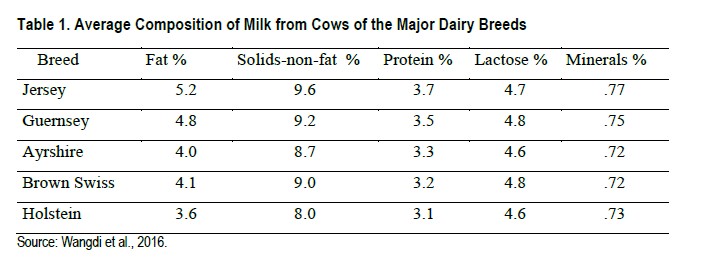
There are obvious differences in milk yield and composition between breeds. The most obvious difference between average milk compositions for breeds is fat percentage. There are obvious differences in milk composition and yield among the various breeds of dairy cattle.
Fat is the most variable constituent of milk whereas minerals (ash) and lactose are the least variable. Differences in gene frequencies controlling the quantity and quality of milk components largely account for the average genetic differences among breeds.
However, differences among individuals within a breed are often greater than differences among breeds. For example, some Holsteins produce milk containing more than 5% fat, and some Jersey produce milk testing as low as the breed average for Holsteins.
The diameter of the milk fat droplet varies from 1 to 10 microns. Guernsey’s have the largest and Holsteins and Ayrshire’s the smallest fat particles.
In general, the higher the fat percentage in milk the larger is the diameter of the fat particle. Also, its size usually decreases as the stage of lactation advances. Carotene, a yellow pigment, is the precursor of vitamin A. Guernsey and Jersey cows convert much less carotene to vitamin A than other breeds of dairy cattle. Thus, milk from Guernsey and Jersey cows is coloured yellow. Humans convert the carotene to vitamin A; thus, milk from these cows provides about as many vitamin A equivalents as milk from other breeds (see Table 1 below).